The Right of First Deployment
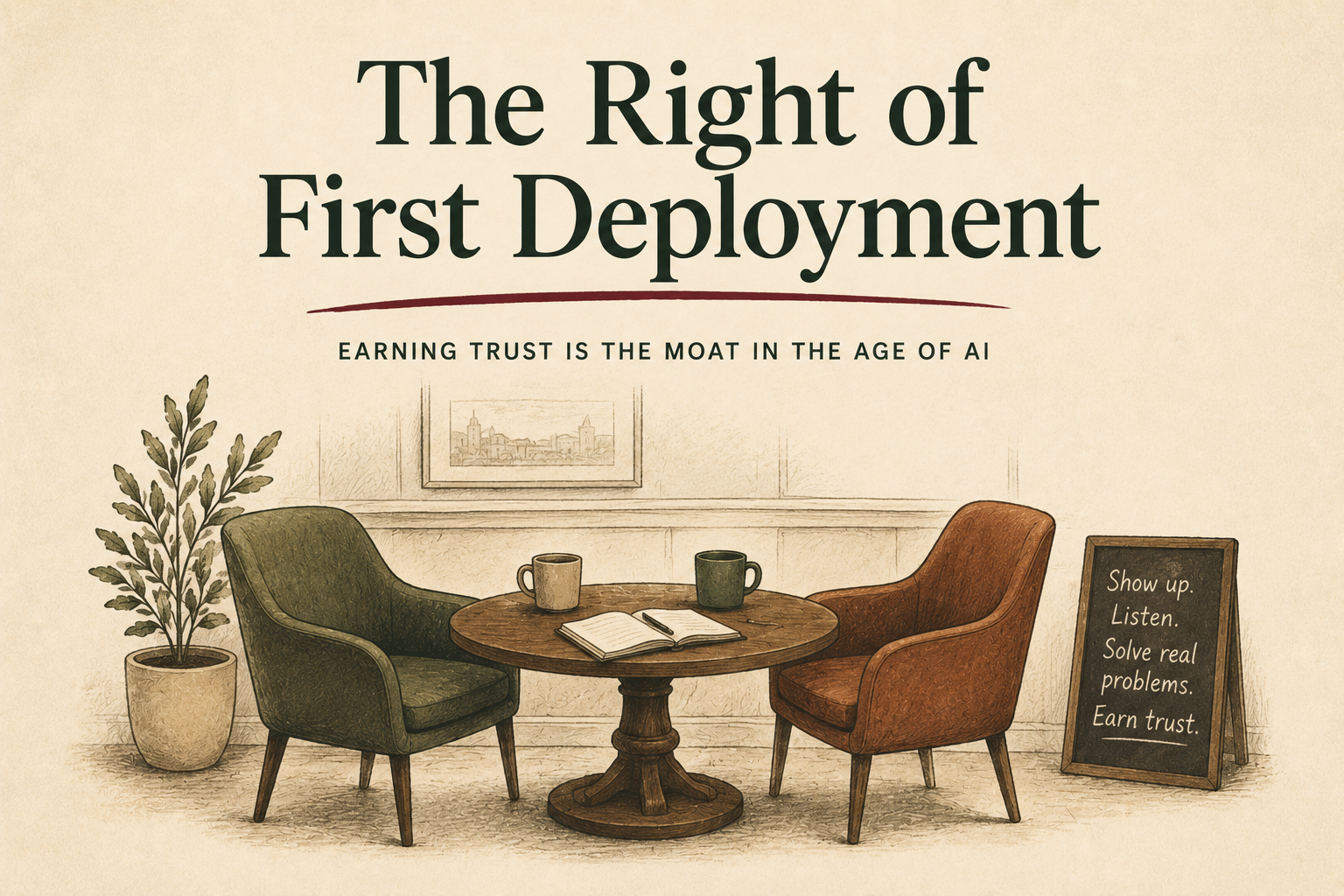
Earning trust is the moat in the age of AI
In March, Julien Bek at Sequoia shared that the next $1T company will be a software company masquerading as a services firm: selling the work, not the tool. No argument here. We believe there is tremendous opportunity in the industries he outlines in his piece, and AI is certainly now good enough to do what he calls "the intelligence work."
One lesser-discussed element, but one that matters most, is his line "Nail distribution." Because if the cost of building software approaches zero, distribution is the game. So how do AI-native companies win the distribution game, especially in industries like manufacturing, industrial, and much of the physical economy, where AI rolls out at the speed of trust, not the speed of release notes? While there is healthy skepticism among these potential customers who are decidedly not AI-native, they are shrewd business people who are willing to invest in better outcomes (you have to be, if you've built a business that's lasted 50+ years).
So how do you bridge the gap? Simple. You show up, build trust, solve a real problem, and generate a business outcome. That's what earns you the Right of First Deployment: the AI equivalent of the financial ROFR. You've shown them what you can do (or what AI can do in your hands), and now they start thinking about the possibilities. So the next time they have a problem or an idea about applying AI to their business, you get the first call. And the one after that. Onboarding a new vendor is expensive in time, attention, and political capital; solve the first problem well, and the second one is yours by default.
Three principles for winning the ROFD:
- Trust is earned, not Zoomed. Most people are skeptical of AI, or at best, concerned. This is especially true of enterprises with decades of customers, data, profits, and a lot to lose. As a result, adoption will require a distinctly human touch. So show up in person, drink the bad conference-room coffee, and become their bridge into the AI opportunity for their business. This trust compounds.
- Services isn't a bad word. It's the wedge in. One-shot deployments are not a thing in AI—yet. Enterprise AI deployments require real hands-on work: setup, integration, customization, and change management. This is especially true for industries where decades of data and workflows are built across a range of legacy systems and databases. You're going to do the work either way; do it onsite, with forward-deployed teams and obsessive responsiveness. Startups that try to stay "pure SaaS" will watch competitors win the relationships that matter. The work is the wedge in.
- Show up with a solution, not a product. Customers want their problem solved, not your roadmap. Keep the solutions you deliver in the neighborhood of your long-term vision (don’t sell yourself into a corner), but solve what brings value to the customer. Over time, the solutions will harden into a product, or the deployment process does. Either way, you've won a customer's trust while others argue about whether to take services revenue.
When most founders have access to roughly the same models, the same tooling, and the same downward cost curve on development, what distinguishes the winners is relationships. It comes down to who the customer trusts enough to call first, who shows up ready to serve, and who puts the problem before the product. The start-ups who get this right won't have to fight for the next AI opportunity; it will be theirs before anyone else knows it exists. That's the Right of First Deployment.
Up next

The Art of Starting from Zero
Upwind, the next-gen wiz, now secures every corner of the AI stack
