BB in the DB: Wine, Moats, and the Right to Win
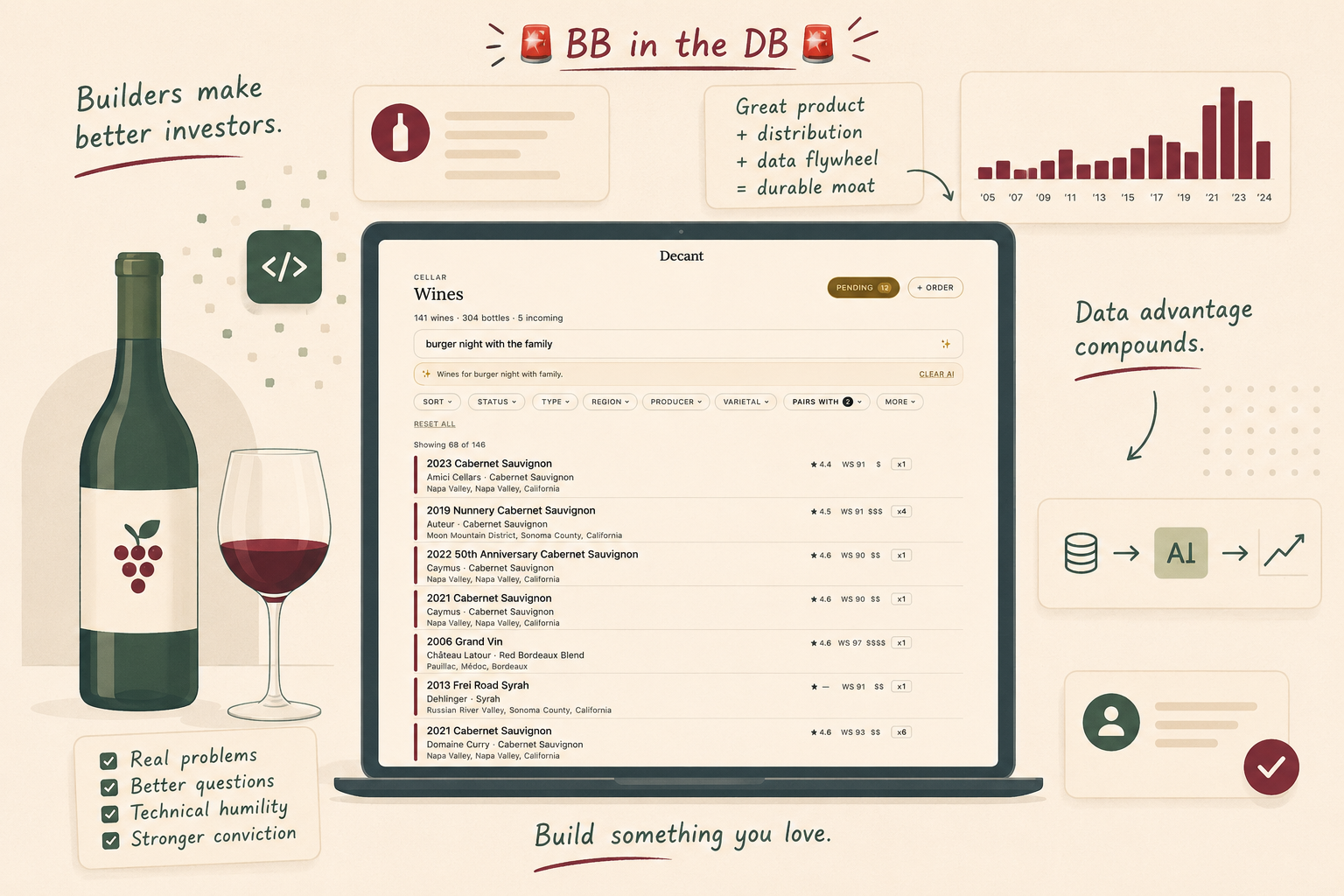
I've never written a line of production code and have no real engineering experience. To better paint the picture, my co-founder at my first company had an automated warning message that alerted him whenever I accessed our product's database: "🚨BB in the DB🚨"
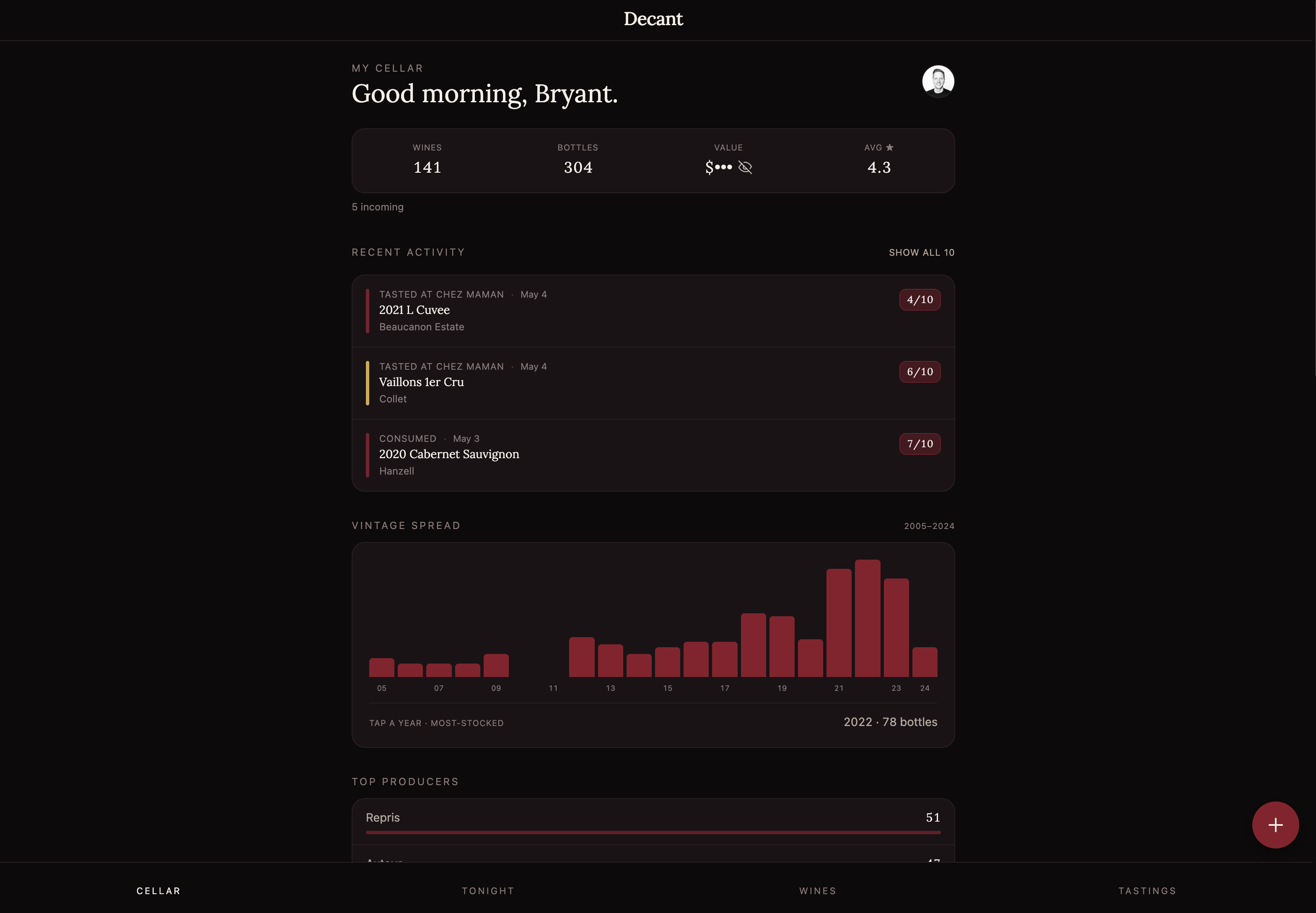
Now, I’ve built “Decant”. It's a personal wine operating system: a cellar tracker, pairing engine, and collection manager rolled into one. I built it because the tool I was originally using left too much on the table. As someone who cares about wine, I knew exactly what was missing.
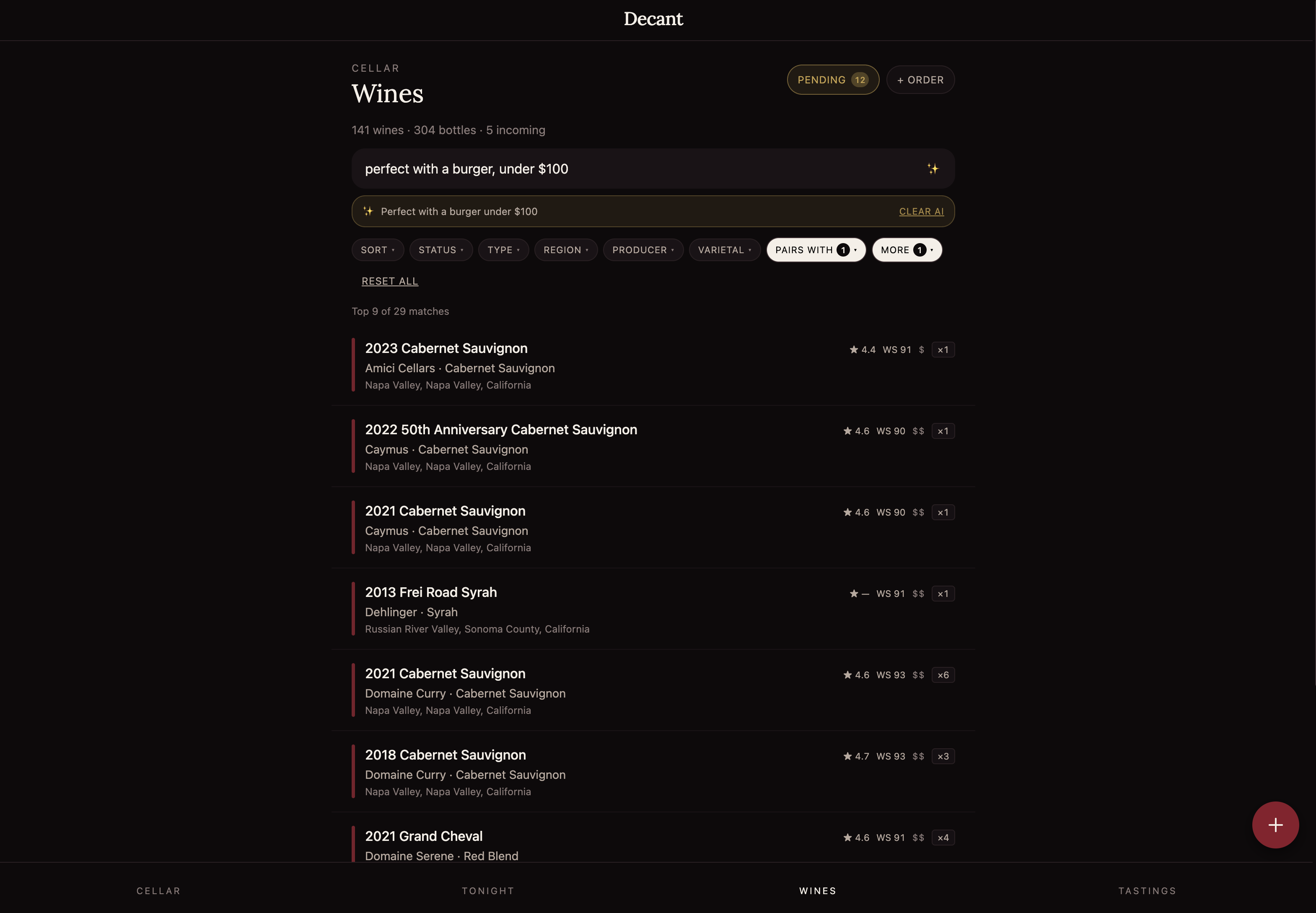
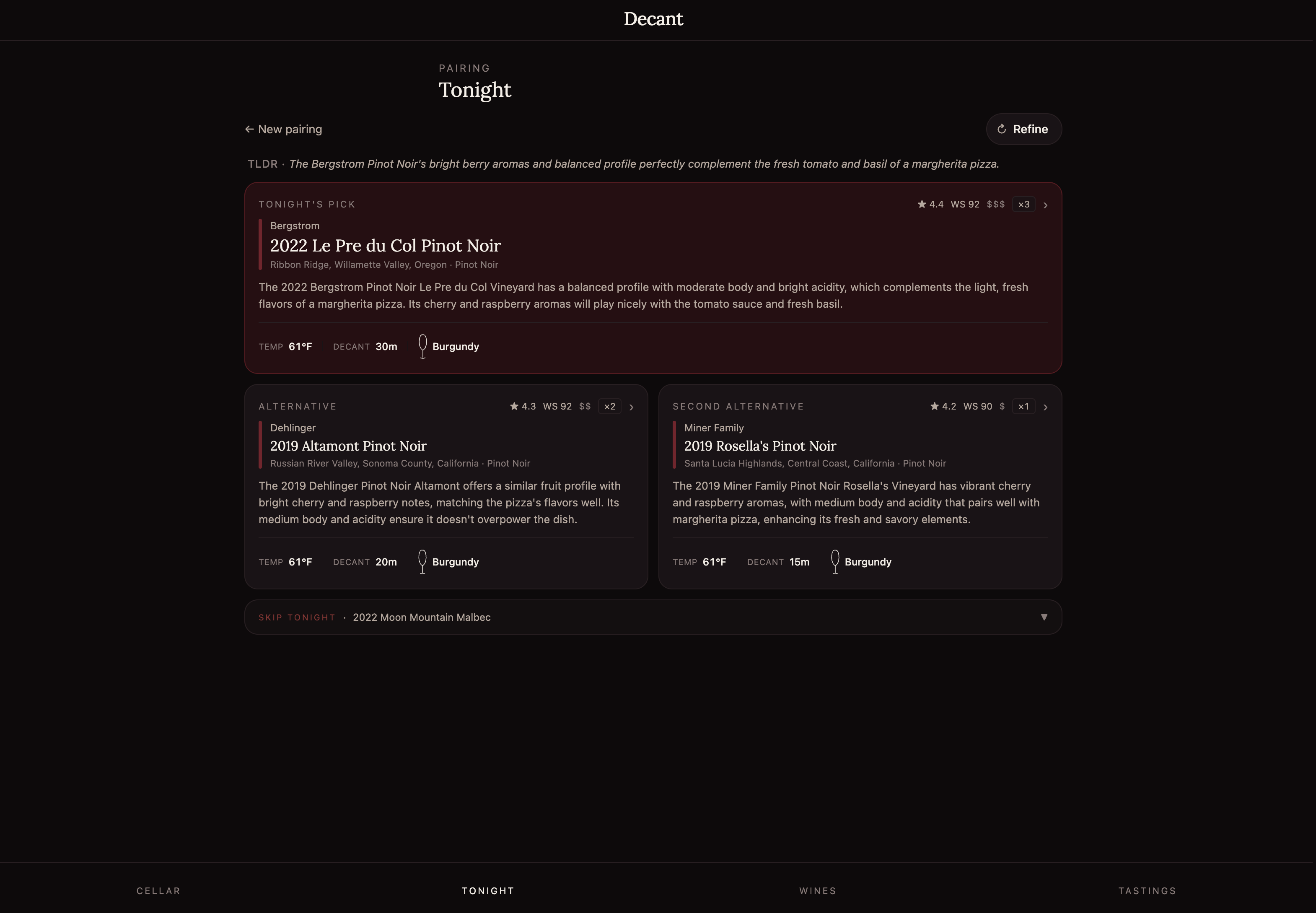
So I built it with Claude Code. 305 bottles. 141 different wines. A pairing engine that draws from my actual cellar. A “Tonight” tab where I type in what we're having for dinner to get a recommendation with serving temperature, decant time, and the right glassware.
The wine app was the excuse. The real reason was Penny Jar. Venture is changing, AI is changing the way we work, and firms that harness it across everything they do will pull ahead. I couldn't read my way to that objective. The only way to develop a real appreciation for how things are being built and to more effectively guide our own technology roadmap was to build something myself.
What I didn't expect was how much building would change how I think, not just about wine, but about product, moats, and how it would improve my interactions with founders.
What Building Teaches You About Moats
The most clarifying thing Decant taught me wasn't that I'd built something defensible. It's that I understood, in a visceral way, exactly where defensibility lives and where it doesn't.
Existing apps like Vivino and Wine-Searcher aren't better than what I built. But they have something I don't: years of accumulated data and the distribution to keep acquiring more. My pairing engine is genuinely good (you be the judge). Their data is genuinely irreplaceable, at least for now.
That tension sits at the center of how we think about investing at Penny Jar. We back seed-stage founders using AI to reimagine how real industries work, often overlooked industries where incumbents are slow-moving, slow to refactor their tech stack, and structurally unable to serve the end customer the way a new entrant can.
The new entrant can build a product that the incumbent could never dream of shipping, and do so in lightning speed. That is table stakes. What separates the companies that win is what comes after: a maniacal, relentless pursuit of distribution and data acquisition.
Product alone is not enough; the composition is what matters: can you build delightful AI-native experiences that deliver outcomes and measurable ROI? Can you pair that with the distribution and data flywheel to make it harder to unseat you over time? The founders who figure out both are building something real. The ones who don’t will be displaced.
Building Decant didn't teach me that lesson for the first time. But it made me feel it for the first time.
The Founder Conversation Changes
I started the way most people do: describing what I wanted in plain language. I want to log my wines. I want recommendations. That gets you somewhere, but not far.
The shift happened when I started hitting walls. Rate limiting on external APIs. Schema decisions that cascaded through the entire database and other challenges. I suddenly found myself having actual conversations about architecture because I had to.
What I ended up with wasn't just a better wine app. It was a working mental model of how products in the world of AI are actually built and where they can gain defensibility.
When I was talking to a founder recently about the data architecture decisions I made and asked him about his own, it made me realize something. There's a version of AI enthusiasm that's theoretical: I see the potential. And there's a version that's earned: I feel the potential. Founders can sense the difference.
Build Something You Love
My partner at Penny Jar, Rich, recently wrote about pursuing joy as the engine that sustains tinkering even after novelty wears off. He's right. The reason I got good enough at this to have real technical conversations is that I never wanted to stop. The project was fun. I kept coming back.
If you're an investor who hasn't built something yet with AI, find the thing you'd actually use every day. Not a proof of concept. Not an experiment. Something that solves a real problem you have, and that you'd pay for if someone else built it first. Then build it yourself.
The software won't be as good as what a team of engineers would ship. That's not the point. The point is that you'll understand, in a way you can't fake, what it takes to build something in this new age that people want to keep using. And that understanding will show up in every founder conversation you have from that point forward.
We talk a lot in venture about pattern recognition. Building is how you earn a new set of patterns.
Turns out BB belonged in the DB all along.
Curious about Decant? I've provisioned a demo account with a sample collection, enough to get a real feel for the pairing engine and the cellar view. Check it out here: Decant Demo.
The stack, for the curious: Supabase on the backend, Apify APIs to scrape Vivino and Wine-Searcher for enrichment data, and OpenAI routing different models to different jobs—gpt-4o for complex reasoning, gpt-4o-mini for lighter tasks. A full set of API refreshes of 145 wines costs about $4.40.
Up next
Breaking the Mold: How Family and Fairness Fuel Maria Colacurcio
An Evening of Inspiration with Stephen Curry