The Courage to Show Up Anyway
The Courage to Show Up Anyway
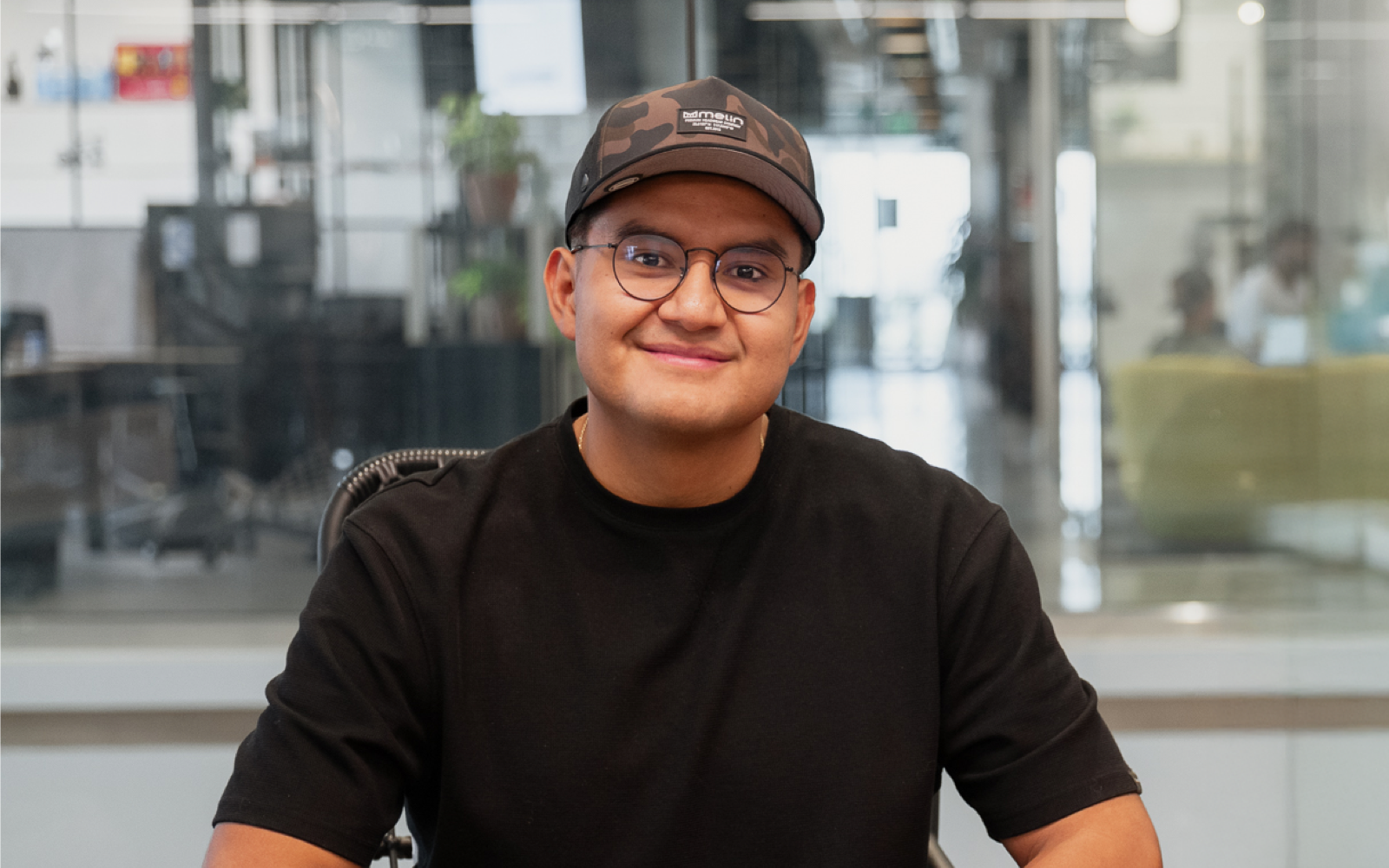
Renato Villanueva was three months old when his parents left Peru for a new life in Utah—there, his life was guided by hard work, faith, and the conviction that showing up, especially when it’s hard, changes everything.
The Principal’s Office
Renato knew he was in trouble—big time. Sitting in the principal’s office of his new elementary school in a small town in Utah, he waited for his parents to arrive. It was just the second week of first grade, but he knew enough to realize that being sent to the office was a bad thing; however, he didn’t quite understand why he was there.
He replayed the scene in his head: his teacher was explaining the lesson over and over to the class, yet despite the teacher’s efforts, the students were not grasping the concept at all. Renato watched with curiosity, already knowing the lesson material from his home studies, and decided to help. He stood up and said to the teacher, “They are not going to understand the lesson if you teach it that way,” and asked if he could try. Unsurprisingly, his teacher was taken aback by his boldness and sent Renato to the office.
When his parents came to pick him up, his mother didn’t scold him. She told him that being outspoken could be a strength — but only if he learned when to use it, and how. The school also took a similar approach, and after consulting with his parents, decided he should take a placement quiz for second grade, where the curriculum would be more challenging—he aced the test.
It was the first of many lessons about embracing his confidence and speaking up while also learning the importance of humility—qualities that would become anchors throughout his life.
Showing up Anyway
His parents' advice was born from experience. When Renato was just three months old, his parents packed up their lives in Peru and moved to Utah with his two older brothers, ages five and seven. They spoke almost no English, had no jobs lined up, and no extended family to fall back on. What they did have was conviction in hard work and each other.

Once in Utah, his father went to the Church of Jesus Christ of Latter-day Saints' employment services office to find work. He got a job supporting a local businessperson, Mr. Mitton, to do work around the house and yard. The family was relieved to have a solid source of income soon. Then, a call came from the office: the job was canceled, and there was no need to return to the house as originally planned. After his father hung up the phone and relayed the message, Renato’s mother told him confidently, “Pretend you didn’t receive that phone call and go anyway. I’m sure there is something you can do.”
He did. Mr. Mitton, visibly surprised to see him at the door, tried to explain that he no longer needed help. Renato’s father was resolute, standing with a big smile and trying his best to communicate his willingness to contribute in whatever way was needed. Mr. Mitton finally relented and assigned him a small project. Renato’s father came back the next day, and the next, and Mr. Mitton kept finding more and more work for him until he was hired full-time.
His father kept that job for decades. Mr. Mitton encouraged Renato’s father to learn English, and upon seeing his skills in construction, encouraged him to start his own business, which he did. They became invested in each other's lives and families, forging a lifelong bond.
Renato’s father’s persistence not only led to a career that would provide for the family, but also taught Renato the value of hard work and to ask for what he wanted, because he might just get it.
Leap of Faith
At the age of four, Renato began playing the piano, and by eleven, he had become quite proficient. His talent was such that when the organist at his church broke his hand and could no longer play, his parents immediately suggested that Renato fill in. His parents assumed playing the organ was like playing the piano, but as Renato says, “They are absolutely not the same.”
Despite the challenge, Renato started teaching himself, figuring out the complicated dance required to coordinate hands, feet, and multiple keyboards simultaneously. Fortunately, his mother also found free classes offered by students in Brigham Young University’s organ performance program to accelerate his learning. Between his mother's support in taking him to lessons and his own dogged determination, he mastered the organ.
Decades later, Renato is still the organist at his church. While the thrill of conquering such a complex instrument initially drew him in, the responsibility of coming back every Sunday keeps him going. After all, an entire congregation relies on him.

Academics, Accelerated
From a young age, Renato’s mother pushed him to pursue education aggressively. The message was clear; there was deep gratitude for the life the family built in Utah, and also hopeful ambition for her children to achieve more. “She was always looking for loopholes,” he says. “She’d find ways for me to take college-level classes early.” By the time he graduated from high school, he had earned enough credits for an associate degree and entered his college career as a junior at the age of seventeen.
Two years later, Renato put his college education on hold to serve his mission for the Church of Jesus Christ of Latter-day Saints in Texas. During these two years, Renato’s respect for discipline grew. Each day, he would wake up at 6:30 AM, exercise, study scripture, and then head out into the world to hit the pavement. The afternoons were filled with long hours of service projects, and walking through neighborhoods, knocking on doors to talk and listen about faith, often to people who didn’t want to do either.
That period reinforced a lesson he absorbed from his parents: persistence isn’t about force—it’s about the quiet discipline to return each day and keep trying.
Path to Parallel
When he came home, he applied that mindset to everything, including his first job search. After completing his degree, he tirelessly searched for a way to join a local startup in Utah's thriving tech sector. Renato offered to work for free to gain experience and build his resume. He finally found his chance at a local venture capital firm that recruited him for a due diligence project on Divvy, a company they were considering investing in that was building a corporate expense management platform.
During the diligence project, Renato became fascinated by the company and what they were building, and was determined to find a way to work there, so he started knocking on doors. He reached out to the Founder and CEO, Blake Murray, expressing his admiration for the company’s vision and product, and his desire to join the company. The CEO replied graciously, explaining the company was only hiring engineers and didn’t have a role for him. Renato said thanks and promised he would be in touch again in the future.
Over the following year, Renato repeatedly reached out to Blake every few weeks with variations of, “Hey Blake, do you have a job for me?” “How about now?” Finally, Renato’s persistence and patience paid off: Blake replied that there was a finance role and that he might be a fit. Hours later, Renato was interviewing for the job that would become the foundation for his tech career. “I just kept at it,” he says. “That’s something I learned from my dad. Just keep showing up, even if you get a no at first.”
Bill.com later acquired Divvy, and there was a sense of “what’s next” for Renato. He loved being at a startup and admired Utah founders like Blake, as well as Qualtrics CEO Ryan Smith. However, similar to his experience in first grade, watching his teacher, he began to think, "I can do that too.” The question was—what was he going to build?
At his friend's prompting, he began coming up with ideas for solutions to some of the most significant pain points in his day-to-day work. After Renato shared his idea for a headcount forecasting solution with a colleague at Divvy, the colleague asked, “If you believe in this idea, why not just quit and go all in?” He took it as a challenge and, as he did throughout his life, faced it with exuberance, quitting his job that very day.
Renato first founded Parallel to solve a very specific problem he faced during his finance career. What he discovered while listening to customers was that addressing headcount was a significant win, but what they really wanted didn’t yet exist: a complete solution to build an elite finance function for early-stage companies without having to hire the team in-house.
He and his co-founder pivoted and refined until they found a solution to meet his customers' needs, and that checked Renato’s box for doing something really hard. Today, Parallel offers an AI-native forecasting platform and a network of dedicated fractional CFOs that together give early-stage companies a complete, always-on finance team.
Parallel wasn’t born out of a lightbulb moment, but through taking that idea and pressure-testing it with customers, knocking on doors, and listening.
Taking Punches, and Winning
Renato describes entrepreneurship as “learning to take punches in the face, again and again.” Yes, founders need to have a great idea, but more than anything, they need to bring enduring resilience—something Renato’s parents modeled for him at a very young age.
Renato’s life's work is built on compounding acts of persistence and determination in pursuit of the next challenge. He likens it to the dopamine hit dogs get during training—it's at its highest before they get the reward, it’s the anticipation of completing the task or challenge.
For Renato, a life well lived isn’t about avoiding difficulty—it’s about choosing it with purpose and staying long enough to see what it becomes.
Up next

The Founder Apple Let Get Away

Our Investment in Syndio
