The Discipline of Wonder
The Discipline of Wonder
For Ophir Samson, success has never been the goal. Curiosity was. From magic to mathematics to building Ezra, his life follows a consistent rule: pursue what fascinates him deeply enough to master.
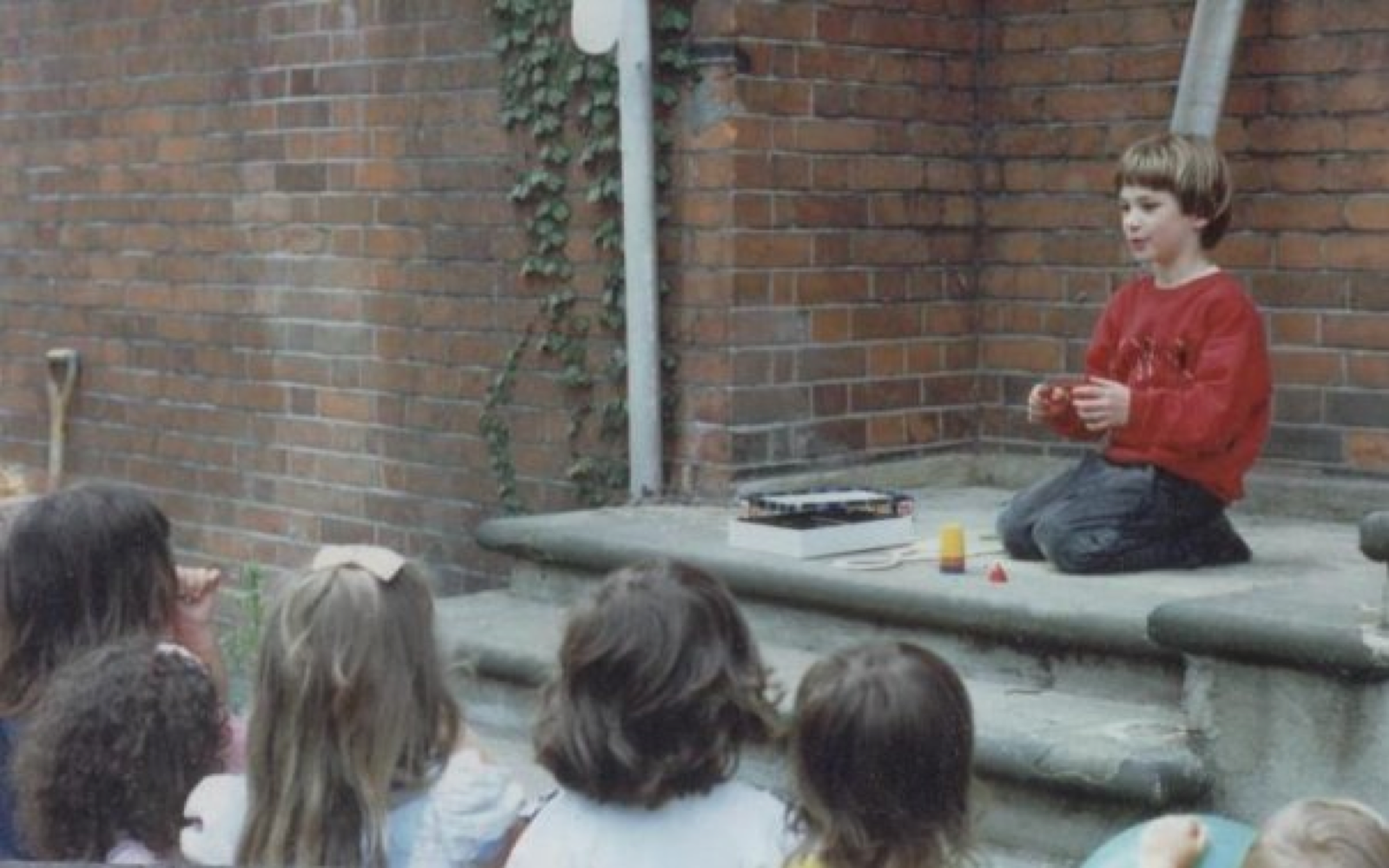
Ophir Samson is rarely without a deck of cards. At the age of three, he received his first magic set and, just two years later, performed his first public magic show for family, friends, and neighbors. As a teenager, Ophir saw magic as a way to make money, and pitched the idea of card tricks as dinner entertainment to restaurants in his North London neighborhood. One after another, restaurants said to “pound sand,” until finally an Italian restaurant gave a tentative yes. After the shock of learning the “magician” was just fourteen, Ophir’s sleight of hand won them over, and he was hired on the spot.
For Ophir, the appeal of magic is twofold. First, it’s about creating a sense of wonder. He reasons there are fewer moments of awe as we grow into adults, yet we inherently keep craving them. Magic fills this void. Second, magic has immense technical depth. Just one trick can take years to develop, let alone master. This mastery is what Ophir loves the most, pursuing something of great depth until it reveals itself completely.

An Unconventional Childhood
As a child, Ophir would often wake to find his father’s latest invention on display in the kitchen, with his father fast asleep after a long night of creating, building, and iterating. The inventions ranged from a magnetic Newton’s cradle to a reclining chair. A physicist by trade, he began his father’s tinkering as a hobby and eventually made it a full-time job. Ophir product tested, including, much to his dismay, a new spill-proof cup for toddlers in front of a high-school girlfriend. While that relationship didn’t last, his father’s invention did, with his patent becoming a blueprint for a popular line of children’s sippy cups.
Ophir’s mother was an accomplished artist. She designed museums and playgrounds for children with special needs and illustrated children’s books. Thanks to the influence of both his parents, Ophir grew up with a clear understanding that science and art were equally legitimate pursuits. Applying this principle in school was more complicated.
Ophir was not a particularly strong student and resisted what felt imposed, especially math. His father believed he could best help Ophir, but his methods were vastly different from the school’s. The more his father pushed, the more Ophir resisted. That changed when Ophir decided to take an advanced math placement exam, reasoning that it would be easier to compete against just the two students with high marks than against the hundred-plus students in his regular class. The school was perplexed given Ophir’s grades, but didn’t stand in his way. The strategy worked. Ophir learned to understand math his way, developing his own relationship with it and making it “his,” not just his father’s.
From that point on, Ophir practiced measuring himself by how deeply he understood something, not by being the best. Ophir believes motivation rooted in comparison is fragile; depth, by contrast, endures.
Intrinsic Beauty Of Math
At Imperial College London, Ophir’s fascination with mathematics deepened. He sustained himself through a range of pursuits outside of his studies—from magic to becoming a salsa dance instructor and training with top chefs. He viewed feeding people as a way to nurture those around him, and the depth of techniques, knowledge, and skill required was equally compelling. Ophir began working in restaurants, later at Michelin-starred restaurants, and with top chefs from San Francisco to Israel. Every hobby was an opportunity to master something complex, to reach the level of a professional without making it his life’s work.

At MIT (Massachusetts Institute of Technology), Ophir’s studies intensified, and doubt resurfaced. Surrounded by people he perceived as far more capable, Ophir at times felt like a fraud. He centered himself by focusing on what he calls “the intrinsic beauty of mathematics,” and not the competition around him. While he learned to enjoy the rigor of the PhD program, he began to question its distance from real-world consequences. The problems were elegant, but increasingly esoteric.
Around this time, he began listening to a Stanford podcast called Entrepreneurial Thought Leaders, which features conversations about applying deep technical thinking to real-world problems. Inspired to make his own impact, Ophir returned to Imperial College, where he accelerated and completed his PhD. After, he joined the first startup he could find, an e-commerce coupon company. A rather unconventional career choice for a PhD in fluid dynamics, but running the business provided enough depth in the short term, and soon enough, the company was acquired by Groupon.
Not long after, the financial crisis hit, and Ophir became fascinated and wanted to understand why it happened. He knew the best way to do so was to learn derivatives, and a role at a hedge fund as a mathematician offered this opportunity. While the work was intellectually stimulating and financially rewarding, it never felt right. Ophir was still looking to make an impact, and the lifestyle of an investment banker just didn’t fit.
One morning, he made the bold decision to resign, packed his bags, and, with the podcast heavy on his mind, booked a flight to San Francisco that evening. On his way to the airport, he emailed the host, Dr. Tina Seelig, to express his admiration for the program and explain how his interest led to an unscripted visit. He added a promise—a magic trick—if he could be a part of one lecture. She agreed.
Impact & Entrepreneurship
When Ophir walked onto the Stanford campus, he felt like a child entering a magical kingdom. The professor welcomed him as a special guest, adding that he would share a magic trick at the end of the class. With a deck of cards at the ready, Ophir delivered. His trick sparked discussion, and one conversation opened the next chapter of his life. He learned about the Israeli Presidential Conference, a gathering of top leaders and thinkers across various fields, including economics, science, and art, to discuss and act on the world’s biggest problems. Ophir was hooked.
One thing stood in his way: the event was by invitation only. It was, however, open to the press, so Ophir convinced an Israeli organization to hire him as a journalist. There, he met Sir Ronald Cohen, chairman of Apex Capital, who gave a speech about social impact bonds. Ophir thought that using capital markets to improve social outcomes was a beautiful way to combine returns to investors with funding for nonprofits. He approached Cohen and secured a meeting that led to a job opportunity in Israel. Ophir established four successful social impact bonds for the company, culminating in a trip to the G8 as an Israeli representative.
Eventually, Stanford drew him back. As he worked toward his MBA, Ophir decided whatever was next needed to offer three things: technical depth, social impact, and a substantial business opportunity. Ophir is centered on autonomous vehicles, given their complexity, the opportunity to prevent vehicular deaths, and their business potential. He fielded offers from Google and emerging start-ups, but an unpleasant Uber ride from the airport changed his course at the eleventh hour. After an executive reached out to apologize, Ophir asked if Uber was considering an autonomous vehicle program of their own. The next day, he shook hands with Uber’s CEO to accept an offer. He spent the next several years leading business strategy and development for autonomous vehicles, first at Uber, then Aurora, and finally GM.

Finding His Voice
In 2023, a series of life and world events once again drew Ophir’s attention inward to ask what was next. Ophir was drawn to voice—to him, the keyboard always felt like such a weird way to communicate. Ophir imagined a future where we interact with computers vocally. He saw this as a technical challenge, but also a deeply human one, reasoning that when we speak, we are more of our true selves, the written word prevents the depth a conversation can reveal.
After throwing himself into learning and researching Voice AI, Ophir’s first company emerged: Juliet AI, a voice AI platform that enables low-latency, context-aware, and natural conversations. His company was soon acquired, but Ophir’s interest in the technology continued.
Ophir turned his attention to the grim reality of one of the toughest job markets in history. He observed that candidates were all beginning to present the same due to AI, but one of the most impactful business decisions, hiring candidates, wasn’t benefiting from similar technological advancements. Ophir thought Voice AI for recruiting could change things, and, most importantly, it checked all his boxes: complex, consequential, and in the early stages with great potential. He soon founded Ezra, a noise-canceling recruiting platform—when a single role gets 500+ applicants, it filters out distractions and surfaces only the signal: the shortlist of candidates who truly fit.
Magic remains part of Ophir’s life. He still performs, for his children, of course, but also spontaneously at gatherings and events in Silicon Valley, often giving crash courses in sleight of hand to tech and sports legends alike.
From his life’s work, applying his mathematical expertise to real-world problems, to his countless hobbies, Ophir’s endeavors are all expressions of the same discipline that has guided him since childhood. Success is never the goal; it’s the byproduct of pursuing his interests deeply enough to master them.
Up next

High School Dropout, Lifelong Rule-Breaker

From Capabilities to Culture: Redefining the Hiring Process